

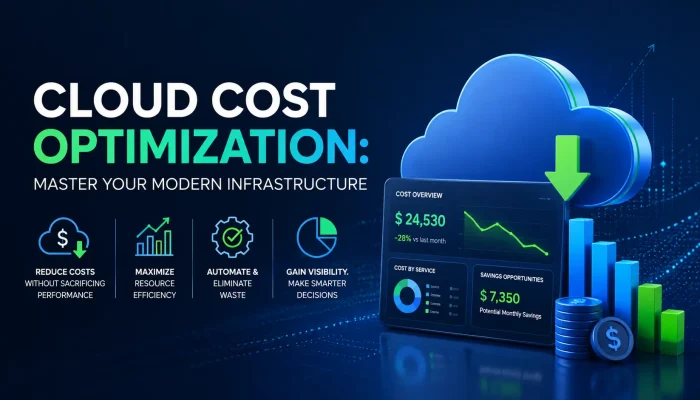

Cloud Cost Optimization: A Practical Guide for Modern Businesses
How to eliminate technical waste, rein in monthly cloud infrastructure invoices, and maintain peak performance.
Moving to the cloud promised massive savings and unmatched scalability. However, many organizations face a frustrating reality: shocking monthly bills and unmanaged resources. Cloud cost optimization is no longer just a technical preference; it is a critical business strategy. Without a disciplined approach, your digital infrastructure can quickly become an expensive liability.
To gain control over your deployment, your business must adopt a proactive strategy centered on cloud cost optimization. Understanding how to manage these operational expenses ensures you maintain high performance without draining your budget.
Why Is Cloud Cost Optimization Critical for Businesses?
Managing remote infrastructure requires a shift from traditional hardware budgeting to dynamic operational spending. If you do not continuously audit your environment, costs can scale faster than your revenue. This operational drift directly compromises the financial health of expanding businesses along the Wasatch Front.
The Hidden Drain of Cloud Waste: A major challenge for modern enterprises is simple inefficiency. Companies often provision excess resources to handle hypothetical traffic spikes that never arrive. This lack of strategic planning leads to massive budget overruns. Prioritizing systematic cloud waste elimination allows you to stop paying for processing power, memory, and storage that sit completely idle.
Shifting Focus to Cloud Financial Management: True efficiency requires alignment between your engineering teams and finance department. Implementing structured cloud financial management frameworks ensures every department takes accountability for their digital footprint. When tech teams understand the financial impact of their architecture choices, the entire organization operates more leanly.
Proven Strategies to Reduce Cloud Spend Effectively
To achieve sustainable, long-term efficiency, you must implement specific, actionable technical tactics across your environment:
- Right-Sizing Cloud Infrastructure: One of the fastest ways to see immediate relief on your monthly invoice. This process involves analyzing the performance metrics of your virtual machines and downsizing configurations that are consistently underutilized. For example, changing a large database instance to a medium or small alternative can instantly cut specific resource bills in half without degrading user experience.
- Capitalizing on Commitments and Discounts: The most costly method of using cloud resources is through on-demand billing. If you have predictable workloads that run continuously, look into long-term commitment contracts. In exchange for a one-year or three-year commitment to a certain amount of compute capacity, major public platforms provide savings as high as 72%.
- Automated Scheduling and Auto-Scaling: Your development and testing environments do not need to run around the clock. By configuring automated scripts to shut down non-production environments during weekends and evening hours, you instantly eliminate unnecessary spending. Additionally, setting up dynamic auto-scaling ensures your infrastructure expands during peak traffic and automatically shrinks when demand drops.
Transitioning to FinOps Best Practices
Achieving deep infrastructure efficiency requires more than just occasional clean-up tasks; it demands a cultural evolution. This is where modern operational methodologies become indispensable.
What is FinOps? FinOps is an operational framework that combines financial accountability with cloud engineering. The goal is to enable teams to make data-driven trade-offs between speed, cost, and performance. Embracing FinOps best practices breaks down structural silos, encouraging developers, system administrators, and financial officers to collaborate daily on budget management.
Continuous Cloud Resource Monitoring: What you do not measure, you cannot optimize. Setting up comprehensive cloud resource monitoring dashboards gives you real-time visibility into your technical stack. These tracking tools allow you to spot sudden spending spikes instantly, trace costs back to specific projects or teams, and rectify configuration errors before they result in a massive bill at the end of the month.
Platform-Specific Solutions for Smarter Spending
AWS Cost Tracking Tools
Utilizes native utilities like AWS Cost Explorer and Trusted Advisor to automatically flag unattached storage volumes, idle load balancers, and old database snapshots.
Multi-Cloud Console Aggregation
Leverages centralized third-party cost management platforms to provide a single, unified view of your infrastructure footprint across multiple different cloud vendors.
Azure Resource Sizing Optimization
Monitors Microsoft Azure environments continuously to match virtual machine allocations directly with performance trends to eliminate ongoing compute waste.
Commitment Discount Metrics
Moving away from standard on-demand cloud pricing structures drastically reduces operational technology spending curves.
Compute Commitments
- Applies to 1-year and 3-year commitments
- Drastically lowers baseline compute costs
- Best utilized for predictable, stable workloads
- Eliminates on-demand financial surcharges
Transitioning predictable, 24/7 business workloads over to reserved capacity contracts represents a core pillar of strategic cloud financial management. According to baseline platform performance indexes, moving from volatile on-demand rates to fixed one-year or three-year resource terms allows organizations to capture savings reaching up to 72%. This structural optimization guarantees resource availability while stabilizing corporate technology budgets over long-term operating horizons.
Frequently Asked Questions
The primary goal is to maximize your return on investment by ensuring every dollar spent directly contributes to business value. It aims to eliminate operational waste and match resource performance precisely with actual workload demand.
Ideally, tracking should happen continuously using automated real-time alerts. Formally, your engineering and financial teams should conduct comprehensive reviews at least once a month to adjust allocations and catch trends early.
If done correctly through careful data analysis, it will not hurt performance. Strategies like right-sizing and auto-scaling ensure your applications always have exactly the resources they need to run optimally, without paying for excess headroom.
Want to maximize your technical infrastructure ROI? Explore our comprehensive Cloud Infrastructure Security and Strategy Guide for more advanced tutorials.
Ready to Stop Wasting Cloud Budget?
Achieving sustainable efficiency in the cloud is an ongoing journey rather than a one-time project. By focusing on right-sizing cloud infrastructure, embracing financial accountability, and utilizing advanced tools to reduce cloud spend, you can protect your margins while building a highly scalable tech stack.
Speak with an Expert