

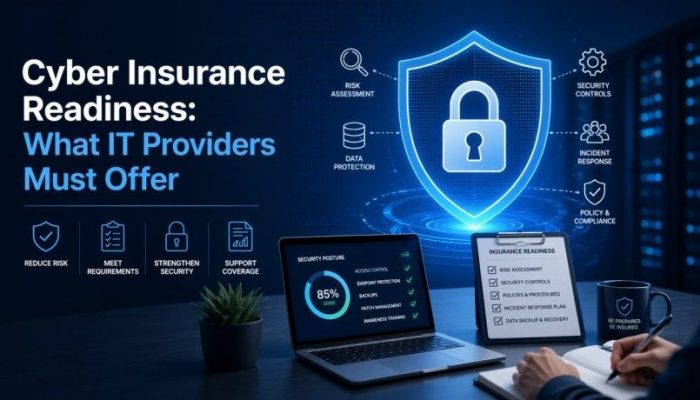

In 2026, cyber insurance is no longer a “nice-to-have” luxury; it is a prerequisite for doing business in a hyper-connected global economy. Insurance carriers are no longer hand-delivering policies based on trust alone. They require verifiable proof of “digital hygiene” and robust security controls.
This shift has fundamentally altered the role of the IT provider from simple “tech support” to a vital compliance partner. This is where managed IT services play a critical role, enabling businesses to deliver the consistent security, monitoring, and compliance support that underwriters demand.
Why Cyber Insurance Readiness is an IT Responsibility
The “Application Gap” is a growing pain point. When businesses receive complex 20-page insurance questionnaires, they cannot answer them accurately without their IT provider. Carriers now hold IT teams to a higher standard, shifting from reactive maintenance to proactive risk management. If a client is denied coverage because of an outdated firewall, the burden of proof falls on the MSP.
The 5 Core Pillars of Insurance Readiness
1. MFA Everywhere
The single most important requirement. If MFA isn’t enabled for email, VPNs, and administrative access, your business is effectively uninsurable in 2026.
2. EDR / MDR
Traditional antivirus is dead. Insurers demand behavioral AI monitoring and 24/7 SOC oversight to mitigate threats outside of business hours.
3. Immutable Backups
To satisfy cyber insurance readiness IT standards, backups must be off-site, air-gapped, and immutable (undeletable) to withstand ransomware.
4. Patch Management
Underwriters want proof that “Critical” vulnerabilities are patched within a 24–48 hour window, documented via a clear automated audit trail.
5. Phishing Simulations
Because human error remains a top threat, monthly phishing simulations and “Security Culture Reports” provide the empirical evidence insurers love to see.
The Paper Trail: Proving Compliance
In the world of insurance, if it isn’t documented, it didn’t happen. A comprehensive readiness checklist must include:
- Incident Response Plans (IRP): Must be tested via annual tabletop exercises, not just a static PDF.
- Network Mapping: Regular hardware and software inventories to eliminate “Shadow IT.”
- Logging and Monitoring: Carriers typically require 90 days of logs for forensic investigations.
Business Benefits Beyond Safety
Positioning yourself as a readiness partner transforms IT from a cost center into a cost-saver. A superior security posture correlates directly to lower premiums and higher coverage limits. When you help a client save $5,000 on their annual premium, the value of your strategic consulting becomes undeniable.
Frequently Asked Questions
Does an MSP guarantee insurance approval?
No. While an MSP provides the technical evidence and IT security controls, the final decision rests with the underwriter’s appetite for risk in your specific industry.
Is EDR/MDR mandatory for all policies?
In 2026, almost every mid-market carrier requires active, 24/7 monitoring. Signature-based antivirus is rarely sufficient for comprehensive liability coverage.
How often should we review readiness?
We recommend a quarterly review. NIST frequently updates its guidelines, and insurance requirements shift just as rapidly.
Bridge the Gap Between IT and Insurance
The safeguards you implement today are the only thing standing between your business and a catastrophic loss. If you aren’t actively managing your insurance readiness, you are leaving your reputation—and your revenue—at risk.
Don’t wait for your renewal to find out you aren’t covered. Contact Solzorro today to ensure your infrastructure is fully protected and insurance-ready.