

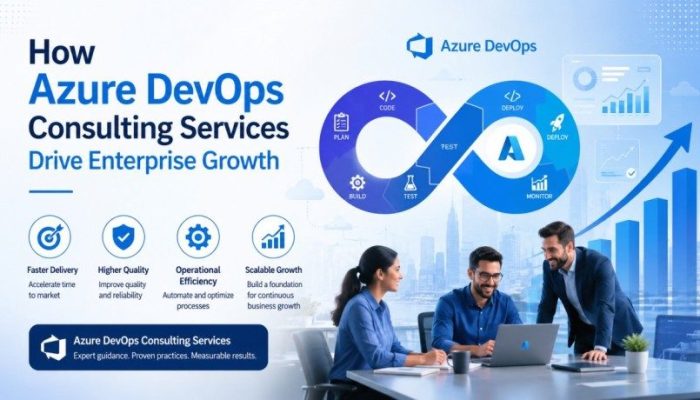

Enterprise Azure DevOps Consulting Services in Utah
How automated CI/CD pipelines, versioned Infrastructure as Code, and integrated DevSecOps engineering accelerate software delivery cycles.
In an era where “software is eating the world,” the speed at which you ship features defines your market position. However, many firms struggle with fragmented workflows, manual deployment bottlenecks, and “siloed” departments. This is where Azure DevOps Consulting Services provides a roadmap to bridge the gap between development and operations.
A professional consultant doesn’t just install a toolset; they architect a culture. By leveraging the Microsoft Azure ecosystem, businesses can automate the mundane, allowing engineers to focus on high-value innovation. From startups to established IT firms, the goal remains the same: faster time-to-market without sacrificing stability.
The Core Pillars of Modern DevOps Strategy
To understand the value of expert consulting, one must look at the specific technical pillars that support a mature DevOps environment. Through professional Azure DevOps Consulting Services, these components work in tandem to create a frictionless delivery stream that aligns with your business objectives.
Continuous Integration and Continuous Deployment (CI/CD)
The automated pipeline is the central component of any DevOps transformation. Consultants help teams move away from “manual pushes” to automated builds and releases. By configuring Azure Pipelines, every code commit undergoes automated testing, ensuring that only high-quality, verified code reaches production. This reduces “rollout anxiety” and allows for multiple releases per day.
Infrastructure as Code (IaC)
Modern infrastructure should be as versionable as application code. Using tools like Terraform or Bicep within the Azure environment, Azure DevOps Consulting Services enable teams to define their servers, networks, and databases in script form. This eliminates “environment drift” where production and staging environments differ, and allows for rapid disaster recovery.
DevSecOps and Compliance Integration
Security is no longer a final checkbox; it is a continuous process. Expert consultants integrate security scanning directly into the pipeline. Tools like SonarQube or Azure Security Center are configured to catch vulnerabilities during the build phase. For industries like healthcare or finance, this ensures that every deployment meets strict regulatory standards like HIPAA or SOC2.
Why Businesses Are Moving to Azure Boards and Repos
Management of the software lifecycle requires visibility. Azure Boards provide a central hub for tracking work, using Kanban or Scrum frameworks to manage backlogs. When paired with Azure Repos, developers gain a high-performance Git-based version control system that supports large-scale enterprise projects.
Azure DevOps Consulting Services assist in migrating legacy codebases (like SVN or older TFS versions) into modern Git repositories. This transition often includes training teams on branching strategies, such as GitFlow or Trunk-Based Development, which are essential for maintaining code quality in large teams.
Measuring Success with DevOps Metrics
You can’t make something better unless you check how it’s doing first. A critical part of consulting involves setting up dashboards to track the “DORA metrics,” the gold standard for measuring DevOps performance:
- Deployment Frequency: How frequently does the company successfully launch into production?
- Lead Time for Changes: How much time does it take to put a commit into production?
- Change Failure Rate: What percentage of deployments lead to a failure in production?
- Time to Restore Service: How long does it take to get back up after a malfunction?
By monitoring these KPIs through Azure Monitor and Application Insights, businesses can identify bottlenecks in real-time and make data-driven decisions to optimize their engineering spend.
Overcoming Common Implementation Challenges
Transitioning to a DevOps model is rarely a “plug-and-play” experience. Resistance to change, lack of internal expertise, and complex legacy architectures often stand in the way.
Professional Azure DevOps Consulting Services act as a catalyst for cultural change. They provide the necessary training to upskill existing staff and implement the governance models required to maintain a secure cloud environment. Whether it’s managing secrets via Azure Key Vault or optimizing cloud costs through automated scaling, a consultant ensures that the technology serves the business, not the other way around.
The Future of Automation: AI and Managed Services
As we look toward the future of digital marketing and IT support, Artificial Intelligence is playing a larger role in DevOps. “AIOps” uses machine learning to predict system failures before they happen and automate incident response. For firms specializing in managed IT services, staying ahead of these trends is vital for maintaining a competitive edge in the Silicon Slopes and beyond.
Strategic Azure DevOps Consulting Services now include the integration of AI-driven coding assistants and automated testing suites that learn from previous bugs. This creates a self-healing infrastructure that reduces the burden on local IT teams and improves overall system uptime.
The Advantages of a “Hub and Spoke” Documentation Model
Just as a hub-and-spoke model organizes complex information for better accessibility, a well-documented DevOps environment uses a central knowledge base. This ensures that as your technical team grows, technical debt remains low and onboarding remains fast, keeping the entire engineering department aligned on best practices.
Azure DevOps Architecture Pillars
Automated Release Pipelines
Architects continuous delivery workflows that validate, stage, and launch product features safely without manual coordination errors.
Declarative Infrastructure
Defines cloud networks, databases, and structural compute layers via versioned script parameters to eradicate environment divergence.
Continuous Security Shielding
Embeds compliance validation rules and static analysis tools natively into standard development queues to stop risks before release.
Conclusion
The journey toward a fully automated, secure, and scalable cloud environment is a marathon, not a sprint. By partnering with experts who understand the nuances of the Microsoft ecosystem, you can avoid the common pitfalls of cloud migration and focus on what truly matters: delivering value to your customers.
Implementing Azure DevOps Consulting Services is an investment in your company’s future agility. It turns IT from a cost center into a powerful engine for growth, ensuring that your software delivery is as reliable as it is fast.
If you’re looking to streamline your deployment pipelines and strengthen your infrastructure for the evolving 2026 compliance landscape, contact us today to speak with our experienced DevOps consultants and discuss a customized strategy tailored to your business goals.
Accelerate Deliveries and Eradicate Environment Drift
Manual configurations create brittle delivery channels and compromise engineering speed. Collaborate with our local platform specialists to transition your release networks into elite automated pipelines.
Request an Azure DevOps Consultation