

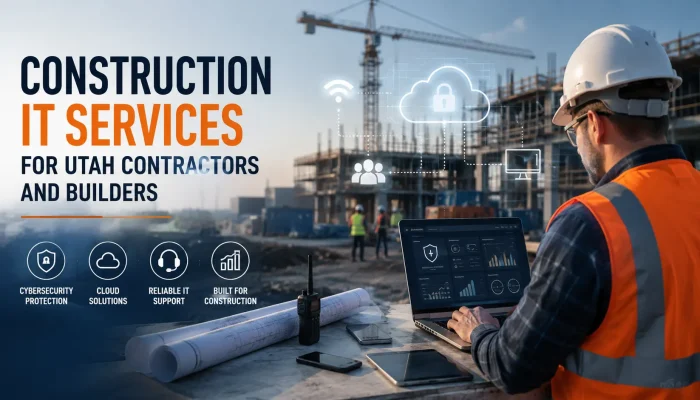

Your superintendent calls before the crew mobilizes. The trailer Wi-Fi is down, nobody can open today’s drawings, and the estimator cannot sync a bid file. Mornings like that are why contractors start looking at construction IT services.
Those outages cost more than an hour. You pay idle labor while the schedule slips, a missed submittal creates contract exposure, and one spoofed invoice can swallow a project’s margin. Standard business IT assumes one office and one network, which is why it fails Utah contractors working across trailers, trucks, and active sites.
Construction IT services close that gap. A provider that knows contractors keeps field and office on one system, secures the accounts attackers target, and makes sure a dead router never stops a pour. Below is what that covers and how to choose one.
What Are Construction IT Services?
Construction IT services combine help desk support, network management, cloud infrastructure, and security monitoring into one managed package built for companies that move between locations every few months.
A general contractor might run six active sites from Ogden to St. George while accounting sits in a Salt Lake City office, each location with its own connectivity. IT services for construction companies account for that spread instead of pretending everything sits behind one firewall.
Why Utah Contractors Feel the Pressure
Utah contractors run lean on overhead, and technology grows faster than anyone plans for. Every new site along the Wasatch Front or down in Washington County adds devices, project logins, and network access, usually without a single person owning it.
Most mid-sized Utah contractors handle IT one of three ways: the office manager who is “good with computers,” a break-fix vendor called only in emergencies, or nobody. Each works until a server fails during closeout or a wire transfer lands in a spoofed vendor account.
What Construction IT Services Cover
A complete construction IT support program usually includes:
- Job site connectivity: Trailer networks, cellular or satellite failover, and secure Wi-Fi that does not rely on a neighbor’s hotspot.
- Project software support: Procore, Autodesk Construction Cloud, Bluebeam, Sage 300 CRE, and Viewpoint integrations that stay synced across field and office.
- Mobile device management: Ruggedized tablets and phones you can wipe remotely when they walk off a site.
- Backup and disaster recovery: Tested restores for project files, accounting data, and email, not backups nobody verifies.
- Construction cybersecurity: Endpoint detection, multi-factor authentication, email filtering, and user training.
- Compliance support: Documentation for insurance requirements, owner contracts, and federal work referencing NIST or CMMC.
How Serious Is the Cybersecurity Risk?
Serious enough that contractors cannot call it a big-company problem anymore. GuidePoint Security’s threat intelligence team recorded 131 ransomware victims in construction during the first quarter of 2026, a 44% jump over the same quarter a year earlier, moving the sector into the five most targeted industries.
Contractors hold vendor banking details, subcontractor tax records, and bid documents, and they run on schedules where a week of downtime destroys margin. That creates payment pressure, exactly what attackers hunt for.
Business email compromise needs its own guardrails. The FBI’s Internet Crime Complaint Center logged $3.04 billion in BEC losses in 2025, most of it wired out before anyone noticed. Attackers sit inside a thread, wait for a real invoice, then send a near-identical copy with new bank details. Strong construction cybersecurity pairs technical controls with a verbal callback rule on any payment change.
In-House IT vs Managed IT Services for Construction
| Factor | In-house staff | Managed IT services for construction |
| Coverage | One person, business hours | Full team, 24/7 monitoring |
| Job site experience | Depends on the hire | Built into the service model |
| Vacation and turnover risk | High | Covered by the provider |
| Security tooling | Purchased separately | Bundled into the stacit suppcyak |
| Scales with new sites | Slowly | Designed for it |
Many contractors run a hybrid model: one internal coordinator who knows the projects, with infrastructure, security, and after-hours coverage handed off.
How Do You Choose the Right Provider?
Not every firm selling construction IT services has worked a job site. Ask for named contractor references in your region, which project management platforms they support directly, and how they would handle a site with no wired internet for two months.
Put response commitments in writing, and confirm whether “response” means acknowledgment or actual work. A provider that can’t show a recent restore log hasn’t tested your backups.
Frequently Asked Questions
What should a construction IT support agreement include?
Scope of covered devices and users, named software platforms, security tooling, backup testing, escalation paths, and who owns documentation if you switch.
Do small construction companies really need managed IT services?
Yes, often more than large firms. Smaller contractors have fewer safeguards, no internal IT staff, and less cushion to absorb an outage.
Can construction IT services work on job sites with poor internet?
Yes. Providers use cellular failover, satellite links, offline-capable apps, and local caching so crews keep working when the connection drops.
What is the biggest cybersecurity threat to construction companies?
Email-based fraud and ransomware. Both usually start with a stolen password or a convincing phishing message rather than a sophisticated technical exploit.
Will a provider support Procore, Sage, or Viewpoint?
A construction-focused provider should. Ask whether they handle integrations between platforms or only the devices that run them.
How does onboarding with a new IT provider work?
Most transitions run two to six weeks. Expect an audit of your sites, devices, and accounts, then documentation, security baselining, and a handover that keeps active projects running.
Bring in a Team That Knows Construction
Technology should keep your projects moving, not turn into another punch list item. The right construction IT services partner knows a delayed RFI costs money and that your network follows the work.
Solzorro supports Utah contractors from the office to the job site with managed IT, cybersecurity, and connectivity that keeps crews building instead of troubleshooting. Reach out to our team to talk through what your current setup is missing.