

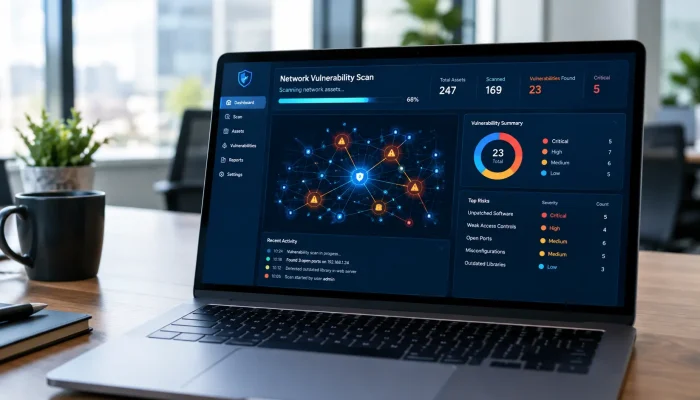

Quick Answer: Vulnerability management is the continuous process of identifying, assessing, prioritizing, and fixing security weaknesses across networks, systems, and applications. Unlike a one-time scan, it runs on a repeating cycle, helping organizations reduce their attack surface, meet compliance requirements, and stay ahead of emerging threats before they turn into breaches.
If your IT team is drowning in scan reports but still unsure which risks actually need attention today, you’re not alone. Most businesses collect plenty of security data. What they lack is a clear process for turning that data into action.
This matters because unpatched software and misconfigured systems remain leading causes of data breaches nationwide. A structured vulnerability management program gives businesses in Utah and beyond a repeatable way to spot weaknesses, rank them by real-world risk, and close them before an attacker finds them first.
Below, we break down how this process actually works, the tools and frameworks that support it, and the practical steps any business can take to build a program that holds up under audit and under attack.
What Is Vulnerability Management?
Vulnerability management is an ongoing security discipline, not a single event. It combines scanning, risk scoring, and remediation into one continuous loop rather than a yearly checklist item.
A weakness might be an outdated plugin, an open port, a default password, or a missing security patch. On its own, a scan just lists these issues. This process adds the judgment layer: deciding what to fix first based on exploitability, business impact, and exposure.
Why It Matters for Utah Businesses
Utah’s growing tech, healthcare, and financial services sectors handle sensitive data that attackers actively target. A single exposed vulnerability in a payment system or patient portal can trigger regulatory penalties, client churn, and costly downtime.
Effective managed cybersecurity services give smaller IT teams the same visibility that enterprise security operations centers rely on, without requiring a full internal security staff. It also supports compliance frameworks like HIPAA, PCI DSS, and SOC 2, which increasingly expect documented, recurring assessments.
The Vulnerability Management Lifecycle
A mature program moves through five repeating stages.
1. Asset Discovery
You cannot secure what you cannot see. This stage maps every device, server, cloud instance, and application connected to the network.
2. Vulnerability Assessment
Automated scanners compare each asset against known vulnerability databases, such as the National Vulnerability Database, to flag weaknesses.
3. Risk Prioritization
Not every flagged issue deserves equal urgency. Teams score issues using severity ratings like CVSS, combined with factors such as whether the flaw is publicly exploited or exposed to the internet.
4. Remediation
This is where fixes happen: patching software, adjusting configurations, restricting access, or applying compensating controls when a patch isn’t yet available.
5. Verification and Reporting
Rescanning confirms the fix worked, and reporting documents the process for audits, leadership, and cyber insurance requirements.
Vulnerability Management vs. Vulnerability Assessment vs. Penetration Testing
Although these names are used interchangeably, they refer to distinct concepts.
| Term | Frequency | Purpose |
| Vulnerability Management | Continuous | Ongoing identification, prioritization, and remediation of weaknesses |
| Vulnerability Assessment | Point-in-time | A single scan producing a snapshot list of current vulnerabilities |
| Penetration Testing | Periodic | Simulated attacks that test whether vulnerabilities can actually be exploited |
This process is the umbrella; the other two are components or complementary activities that feed into it.
Common Tools and Frameworks
Most programs rely on a mix of automated scanning tools such as Nessus, Qualys, or Rapid7, paired with a framework for prioritization. The CVSS scoring system and CISA’s Known Exploited Vulnerabilities catalog are widely used industry references for deciding what to patch first.
Best Practices for an Effective Program
- Scan continuously rather than annually; new vulnerabilities surface daily
- Prioritize by exploitability and exposure, not severity score alone
- Set a patching SLA, such as 15 days for critical vulnerabilities
- Track remediation metrics to show progress over time
- Extend scanning to cloud assets, remote endpoints, and third-party vendors
How Often Should You Run Vulnerability Scans?
Most security frameworks recommend scanning internal networks monthly and internet-facing assets weekly. Critical systems handling payment or health data often warrant continuous, automated scanning rather than fixed intervals.
FAQs
What is vulnerability management’s primary objective?
The goal is to reduce risk by finding security weaknesses early and fixing the ones most likely to be exploited, before attackers do.
Is it the same as patch management?
No. Patch management is one remediation method within this broader process, which also covers configuration changes, access restrictions, and risk scoring.
How long does it take to fix a critical vulnerability?
Best practice targets 15 days or fewer for critical, actively exploited vulnerabilities, though timelines vary by system complexity.
Do small businesses need this kind of program?
Yes. Attackers frequently target smaller businesses precisely because they assume weaker defenses and slower patching cycles.
What distinguishes a threat from a vulnerability?
A threat is the possibility that someone will take advantage of a vulnerability, which is a weakness. This process addresses the weakness side of that equation.
Can this process be automated?
Scanning and reporting can be largely automated, but prioritization and remediation still require human judgment to weigh business context.
Final Thoughts
Vulnerability management isn’t a one-time project you finish and forget. It’s a continuous habit that separates businesses that catch problems early from those that read about them in a breach notification letter. Building that habit takes the right tools, a clear process, and someone watching the results.
That’s where Solzorro comes in. If you’re ready to move from scattered scan reports to a program that actually reduces risk, reach out to our team for a vulnerability assessment and a straightforward plan for what to fix first.